May 17, 2012

Downward Pointing Triangle 1--Yoni---Harappa


The Downward Pointing Triangle Series


Harappan Dancing girl
The downward pointing triangle has been a sign for the female genitals for millennia. I’ll start with an image that Sir John Marshall, the British archeologist who excavated Harappa and Mohenjodaro, wrongly called ‘the dancing girl.’ She is not a dancing girl at all, but merely a nude, confidently posed young female. Marshall, with his British Puritanical point of view, saw such nudity and confidence with a 19th century ‘male gaze’(and 20th and 21st) —she must have been ‘dancing’ for the enjoyment of men.


Even the Government of India, Department of Health and Family Welfare, has continued this downward triangle motif in their efforts to promote family planning/birth control. 


An image of the worship of a schematic yoni—downward pointing triangle, with clitoris shown as well—from the temple at Kamakhya in Gauhati, Assam

More to be added later....

Havan-fire pit (jan’s collections)
Kobar (childbirth traditions)
Rajasthani wall paintings
Yantra 


May 05, 2012


These stories I just read in Jan Tritten's FB page seem so important, I just wanted to share them


Tell us a story where you were able to resolve a tough situation in a birth with creative, outside the box thinking.
 ·  ·  · 11 hours ago · 
  • 4 people like this.
    • Debby Sapp I felt a hand up by the baby's head and lightly pinched it. Baby moved hand; mom was in less pain; and baby was born soon. Another time, I felt a foot and tickled it. Baby moved the foot up!
      11 hours ago via mobile ·  ·  14
    • Amy Willen Mom's cervix had swollen in transition and was not opening any more - she was exhausted. We filled a sterile glove with crushed ice and used it as an cervical ice pack (!). Swelling disappeared, as did the rest of the cerivx, mom felt energized by the change in plans and soon began bearing down.
      11 hours ago ·  ·  11
    • Billie Ferrell Harrigan Mom was stuck at 9cm and her cervix was swelling hugely. The midwife agreed to wait for another 20 minutes before the OB was called for a consult, and I gave mom homeopathic gelsemium.Shortly after, all the swelling was gone and she was pushing out her fully posterior 10lb baby.
      10 hours ago ·  ·  7
    • Patricia Couch This question just made me lol. :)
      10 hours ago via mobile ·  ·  1
    • Steph Landis Bernholz While supporting a stillbirth induction, turned c-section @ a hospital where Doulas aren't allowed in the OR, I followed the anesthesiologist out of the labor room and told him how important it was to the family that they have support during the surgery. We had already been told, "no", by the ob. I told him that if he had any authority over the decision, it would make such a huge impact on all of our lives. He came back w/ scrubs for Lexi & me:-) We were able to photograph and help clean up baby & care for her till Mom & Dad were ready to receive her. Such a blessing!
      9 hours ago via mobile ·  ·  3
    • Tessa Neilson As a doula/TCM, I walked into a home birth where the midwife had called me because she had 'failed to progress'. The midwife told me how she'd be in labour 20 hrs and was only 4cms and what could I do. I told her a couple ear points and within an hour she should be good to go. I could tell she didn't believe me. She was stressed!! I spoke calmly and with assurance to the Mama Supreme. I told her how her body had the innate knowledge to do what's best. And then I told her that her contractions or 'birth sensations' were about to get a whole lotta strong, but that is a GOOD sign and to go with it. I made everyone stop chatting. No more noises to allow her to concentrate and connect and open up to what was going on inside. And then I connected and meditated on the same. Baby born 20min later. Check:)
      9 hours ago via mobile ·  ·  6
    • Tessa Neilson PS midwife told me she was ready to transfer. Sometimes you gotta gound out the stress in the room. Feel the fear and push it through yourself. And then everyone else follows suit and chills out. Haha. Birth is about allowing what is natural. Grounding energy. Do it yourself first.
      9 hours ago via mobile ·  ·  1
    • Beth Bailey Barbeau Labor for first baby had been moving along briskly, expected birth within the hour as grunting began. Progress slowed dramatically as pushing became more intense and then is just got more and more muddled. Pretty much every thing tried over next 6 hours. Finally asked sister if just passed over grandmother was a worrier ("YES!") and would she hold on to the baby ("YES!"). Asked permission to talk to her mom, respectfully asked Grandma to release the baby, and to end her daughter's suffering by trusting her work. Then sister asked in their native language. We were interrupted at this point by the doula calling from the bathroom - baby suddenly coming!
      5 hours ago ·  ·  1
    • Benson Milimo While conducting a birth in a rural nursing home, baby born with mucus unable to breath, ambubag absent. I put a gauze over the babys mouth and used mouth to mouth lung ventilation. Baby improved.
      49 minutes ago · 

April 16, 2012

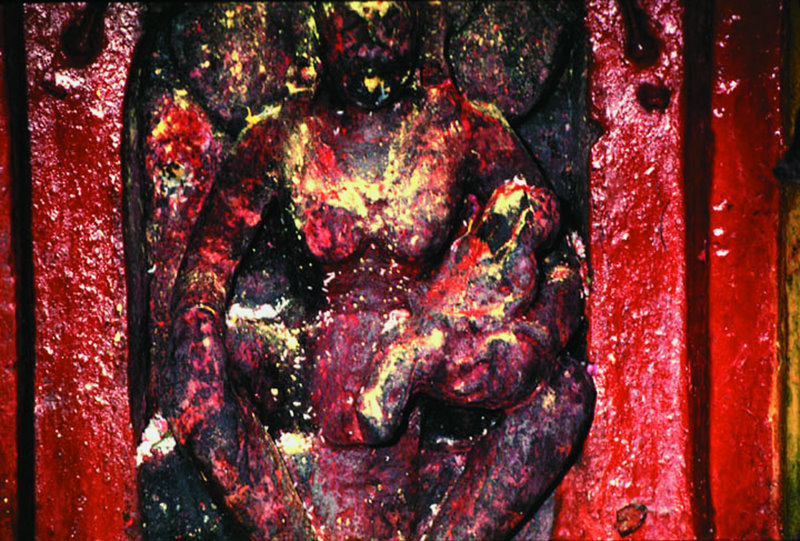
Hariti--Goddess or Demoness....or Both


One of the problems of today is the good/bad split. My 6-year old granddaughter (while we’re watching on television the cartoon myth of Indra being jealous of villagers’ worship of Krishna) asks me if Indra is a bad guy. Then, reading the Amar Chitra Katha comic book version of ‘Indra and Sachchi’ she says that she thought Indra was bad and here he’s good, the hero. She’s confused.
According to me the sophistication of Indian cultural heritage is precisely this ‘confusion’--this both/and not either/or. In these dramas gods are doing bad things and demons doing good things. This is a nuanced morality—actually we’re all both ‘bad’ and ‘good.’

This image of Hariti, obviously under worship as it is smeared with vermillion and oil, is probably from Nepal. That is where I have seen Hariti streetside shrines—and in Kathmandu there is a small, beautiful wrought iron acknowledgement of her in the prominent hilltop stupa Swayambhu. Interestingly it is the only area where you are not allowed to take photographs.

Who is Hariti? Scholars Shanti Rosario and Geoffrey Samuel, in their book Daughters of Hariti: Childbirth and Female healers in South and South and Southeast Asia write of the figure Hariti.
"Her worship seems to have been particularly important in Gandhara and Mathura (present day Pakistan and North India, first century BCE to fourth century CE). Her legend describes her as a child-eating demoness who was converted by the Buddha. Perhaps, though, this negative depiction reflects a process in which respected yaksha and yakshi (nature spirits, deities of prosperity and fertility) such as Hariti and her consort Pancika were brought into a subordinate relationship with the newly developing Buddhist and Brahmanical pantheons."

In other words, to begin with she was a female both/and—both ‘bad’ (if your baby died—she was responsible thus the term ‘child-eating’. If everything went fine she was ‘good’.) It’s only when the high or dominant religions come along that she gets demonized and demonic ONLY.
I don’t know of the historical connections, but she bears a striking resemblance to the birth goddesses or, if you will ‘spirit guides,’ of indigenous midwives; Shoshti Ma in Jharkhand and Bengal, Bemata in other parts of North India and Satavi in Maharashtra. It is a tribute to Hariti and women who do birth and healing work that Rosario and Samuels named their book ‘Daughters of Hariti’!


December 23, 2011

Parvati's Menstrual fluid and the Birth of Ganesh


This is a fabulous image depicting another story of the birth of Ganesh. Many of us know the myth of Parvati bathing and asking her son to guard the door and Shiva approaching only to find his way blocked by this child. In his anger he takes out his sword and beheads the boy. Upon finding that this was indeed his son he (with his magic powers) restores his life and replaces the head with that of a nearby elephant. Ouch!

This image, however, tells a far more peaceable tale. I think it’s to be found in the Ling Puran. Anyway, Parvati wants a baby and Shiva doesn’t. She begs for a child, he says “No, no, we’re perfectly content just the two of us. She persists and begs him “Please, I want a baby.” (Sound familiar?) Parvati keeps bugging him. Finally Shiva relents and tosses her red dress-cloth (read menstrual cloth) into her lap. She is irritated. “Don’t tease me, this is just my red dress.”

Shiva says “Listen to me, just put that red cloth to your breast.” Parvati, disbelieving but obeying, puts it to her breast. Lo and behold, there appears Ganesh, her desired baby.

Now what’s going on here? What I like is that encoded in this story is a very woman-centered version of female biology and the creation of a child. There is no mention of male seed or the family line.

Ganesh is born first from female desire, not patriarchal dictates. Secondly he is born from her bodily power, menstrual fluid, and not male seed. Thirdly it is the womanly act of breastfeeding which quickens the infant, nurtures and brings Ganesh fully alive!

This is just one example of the woman-centered, female body centered truths encoded in some Indian myth, story and image.